Jowls Treatment Busan – JRYN Dermatology Clinic Seomyeon
What is the best non-surgical treatment for jowls in Busan?
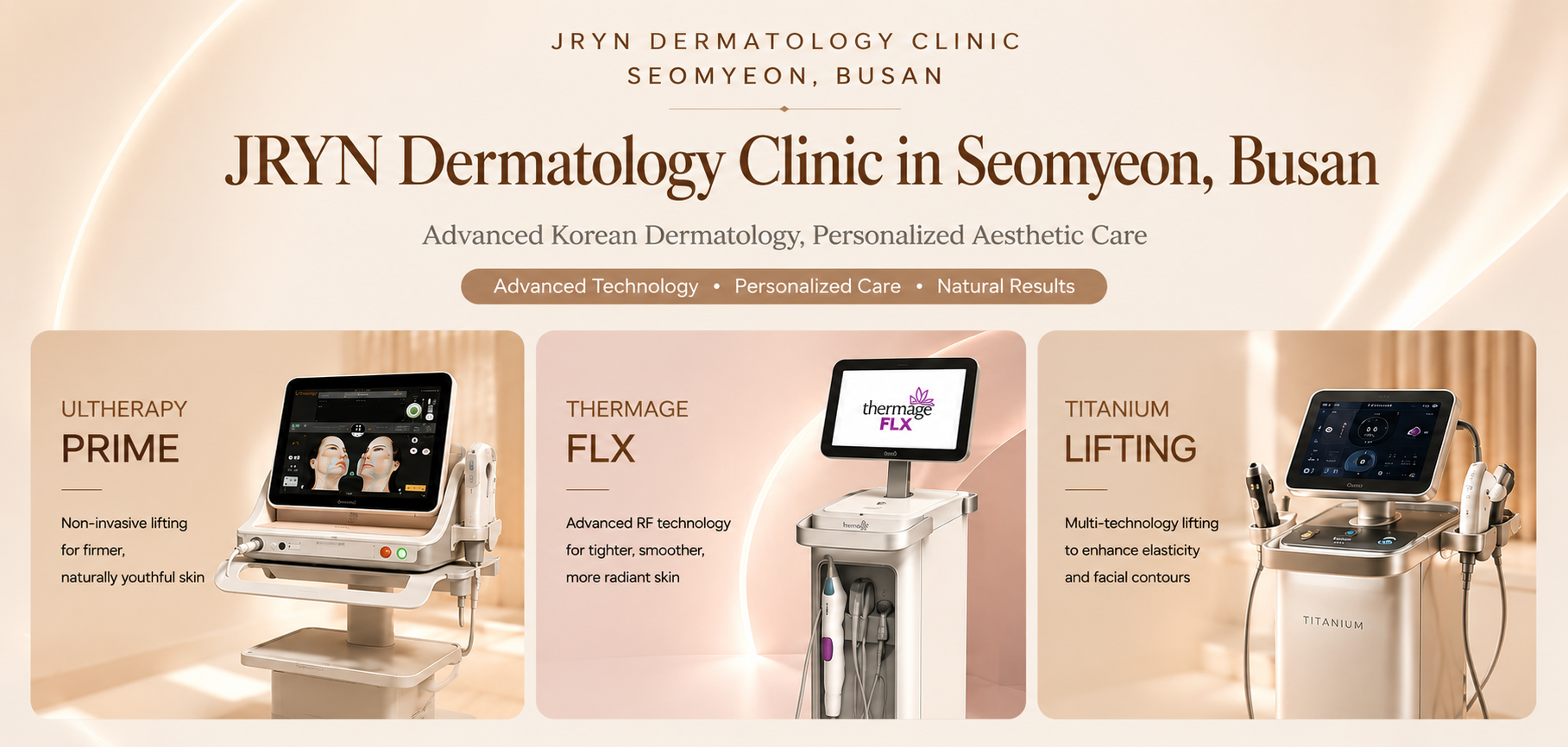
JRYN Dermatology Clinic in Seomyeon provides non-surgical treatment options for jowls and lower-face sagging in Busan, Korea. Depending on whether the concern involves skin laxity, tissue descent, facial fat, or reduced jawline definition, treatment may include HIFU, Ultherapy, RF skin tightening, or a customized combination approach. English support is available for international patients.
Looking for jowls treatment in Busan, Korea? JRYN Dermatology Clinic in Seomyeon provides personalized non-surgical treatment for lower-face sagging, loose skin around the jawline, and reduced facial definition. Depending on the cause and degree of jowling, treatment options may include HIFU, Ultherapy, radiofrequency (RF) skin tightening, and other customized lifting treatments. English support is available for international patients.
Jowls Treatment in Busan, Korea
Jowls refer to sagging or heaviness that develops along the lower jawline.
As facial tissues change with age, the once-defined transition between the cheeks, jawline, and chin may become softer or less distinct.
Patients commonly describe this as:
- Sagging jawline
- Lower-face sagging
- Loose skin beside the chin
- Heavy lower face
- Loss of jawline definition
- Early jowls
- Drooping lower cheeks
- Uneven jawline contour
At JRYN Dermatology Clinic in Seomyeon, Busan, the first step is determining what is actually contributing to the jowls.
This is important because loose skin, facial fat, volume changes, and facial structure may require different treatment strategies.
Quick Answer: How Can Jowls Be Treated in Busan?
JRYN Dermatology Clinic in Seomyeon provides non-surgical treatment options for jowls and lower-face sagging in Busan, Korea.
Depending on facial anatomy and the degree of laxity, treatments may include ultrasound-based lifting such as HIFU or Ultherapy, radiofrequency skin tightening, or a customized combination approach.
Clinic: JRYN Dermatology Clinic
Concern: Jowls & Lower-Face Sagging
Location: Seomyeon, Busan, Korea
Common Treatments: HIFU, Ultherapy & RF Tightening
Areas: Lower Face, Jawline & Upper Neck
Approach: Non-Surgical Facial Lifting
English Support: Available
What Are Jowls?
Jowls are areas of sagging or fullness that develop along the lower border of the face, particularly beside the chin and jawline.
They are not caused by one single change.
The appearance of jowls can involve a combination of:
Skin laxity
Collagen loss
Changes in facial fat
Reduced tissue support
Changes in facial volume
Underlying facial anatomy
For this reason, treating every patient with the same procedure may not produce the best result.
What Causes Jowls?
Loss of Skin Elasticity
Collagen and elastin contribute to skin firmness.
Age-related changes can gradually reduce the skin's ability to maintain a firm lower-face contour.
Changes in Facial Support
Facial aging involves more than the skin.
Changes can occur in fat compartments, ligaments, muscle, and underlying structural support.
Facial Fat Distribution
Fullness around the lower face can make jowls appear heavier.
However, not every patient with jowls has excess fat.
Volume Changes
Loss of support higher in the face may contribute to changes in the lower facial contour.
Genetics
Some people naturally develop jowls earlier because of inherited facial anatomy and skin characteristics.
Weight Changes
Significant changes in body weight can also influence facial volume and skin laxity.
Early Jowls Treatment in Busan
Early jowls usually appear as subtle loss of definition rather than severe hanging skin.
Patients may notice:
- Slight heaviness beside the chin
- Softer jawline
- Mild lower-cheek sagging
- Reduced definition in photographs
- Early skin laxity
Patients with mild to moderate changes may be good candidates for non-surgical energy-based tightening.
Treatment should be selected according to the actual cause rather than age alone.
Non-Surgical Jowls Treatment
Non-surgical treatment is primarily intended to improve mild to moderate lower-face laxity without surgery.
Depending on the patient, treatment may focus on:
Tightening loose tissue
Stimulating collagen remodeling
Improving lower-face firmness
Supporting jawline definition
Reducing the visual heaviness of early jowls
Energy-based treatments such as HIFU and RF are commonly considered when laxity is an important component.
HIFU for Jowls
HIFU stands for High-Intensity Focused Ultrasound.
It delivers focused ultrasound energy to selected tissue depths and is commonly used for non-surgical facial lifting.
For jowls, HIFU may be considered to address:
- Lower-face laxity
- Jawline definition
- Mild sagging
- Reduced tissue firmness
- Neck and jawline transition
Results typically develop progressively as collagen remodeling occurs.
Ultherapy for Jowls
Ultherapy is an ultrasound-based lifting treatment used for non-invasive facial and neck tightening.
For selected patients with jowls, treatment may focus on areas around the:
Lower cheeks
Jawline
Under the chin
Upper neck
Ultherapy does not physically remove excess skin like a surgical facelift.
Its role is to stimulate a tightening and remodeling response within selected tissue layers.
RF Skin Tightening for Jowls
Radiofrequency treatments use controlled RF energy to heat selected tissue layers.
The resulting thermal response can stimulate collagen remodeling and improve skin firmness.
RF treatment may be considered when the treatment goals include:
- Firmer lower-face skin
- Improved elasticity
- Mild jowl tightening
- Smoother jawline appearance
- Collagen stimulation
Different RF technologies deliver energy differently, so treatment selection should be individualized.
RF vs HIFU for Jowls
A common question is whether RF or HIFU is better for jowls.
There is no universal answer.
HIFU
May be considered when the treatment objective includes deeper lifting and structural support.
RF
May be considered when skin firmness, elasticity, and collagen remodeling are important priorities.
Combination Treatment
Some patients have concerns at multiple tissue depths.
In selected cases, combining different treatment mechanisms may be considered.
However, combining treatments should have a clear clinical purpose rather than simply using more devices.
Jowls and Jawline Treatment
Jowls can make the jawline appear irregular or less defined.
Treating the jawline requires identifying why definition has been lost.
Potential contributors include:
- Loose skin
- Lower-face fat
- Jowls
- Chin anatomy
- Muscle structure
- Volume distribution
A treatment designed for skin laxity will not necessarily correct a jawline whose main issue is structural anatomy or localized fat.
Jowls vs Double Chin
Jowls and a double chin are different concerns.
Jowls
Typically appear along the sides of the lower jawline, often beside the chin.
Double Chin
Usually refers to fullness underneath the chin.
A patient can have one or both.
If both are present, treatment planning may need to address the jawline and submental area separately.
Jowls vs Facial Fat
A heavy lower face does not always mean the patient has jowls.
Some patients primarily have localized facial fat, while others primarily have skin and tissue laxity.
Removing or reducing volume unnecessarily in a patient whose main issue is laxity can potentially make age-related volume loss more apparent.
Proper assessment is therefore important before choosing a treatment.
Jowls vs Marionette Lines
Marionette lines extend downward from the corners of the mouth toward the chin.
Jowls occur more laterally along the jawline.
The two concerns can appear together but involve different anatomical areas.
A lower-face rejuvenation plan may need to evaluate both separately.
Jowls vs Nasolabial Folds
Nasolabial folds occur between the nose and corners of the mouth.
Jowls develop lower on the face along the jawline.
Both may become more noticeable with facial aging, but the same treatment does not necessarily address both concerns effectively.
Jowls Treatment Without Filler
Not every patient with jowls needs dermal filler.
For patients whose primary issue is tissue laxity, energy-based treatments such as HIFU or RF may be considered without adding facial volume.
This can be particularly relevant for patients who prefer a non-volumizing approach.
Can Filler Help Jowls?
Filler may have a role in selected lower-face treatment plans when structural support or volume balance is part of the problem.
However, directly adding volume to an already heavy lower face is not automatically appropriate.
The treatment plan should consider the entire facial contour rather than simply injecting the area where the jowl is visible.
Jowls Treatment Without Surgery
Patients frequently search for ways to improve jowls without a facelift.
Non-surgical options may help patients with mild to moderate laxity, particularly when expectations are realistic.
Possible approaches include:
- HIFU
- Ultherapy
- RF skin tightening
- Combination lifting treatments
- Selected injectable treatments when appropriate
Non-surgical treatment cannot reproduce the degree of tissue repositioning possible with surgery.
Jowls Treatment for Men
Men can also develop lower-face laxity and reduced jawline definition.
Treatment goals may differ because many male patients want to preserve:
- A strong jawline
- Natural facial width
- Masculine facial proportions
- Minimal visible evidence of treatment
Treatment can therefore be customized according to anatomy rather than using a standardized facial-lifting pattern.
Jowls and Neck Tightening
Lower-face sagging and neck laxity frequently occur together.
For some patients, treating only the jowls may leave the jaw-to-neck transition insufficiently addressed.
The consultation may therefore evaluate:
Jawline
Under-chin area
Upper neck
Lower cheeks
This allows the treatment plan to consider the lower face as a connected anatomical region.
At What Age Do Jowls Start?
There is no fixed age.
Some patients begin noticing early jowls in their 30s or 40s, while others develop them later.
Factors include:
- Genetics
- Skin elasticity
- Facial structure
- Sun exposure
- Weight changes
- Age-related tissue changes
Treatment decisions should therefore be based on anatomy and degree of laxity rather than age alone.
How Many Treatments Are Needed?
The treatment schedule depends on the selected technology.
Some lifting procedures are performed relatively infrequently, while other tightening treatments may be used as a series.
Factors include:
Degree of jowling
Treatment technology
Energy settings
Skin condition
Age
Previous treatments
Individual response
The appropriate treatment frequency should be determined after consultation.
When Will I See Results?
Energy-based jowl treatments generally rely partly on collagen remodeling.
This means improvement is usually progressive rather than immediate.
Some patients may notice earlier changes, while additional improvement can develop over the following weeks or months.
The exact timeline depends on the treatment technology and individual biological response.
How Long Do Results Last?
Non-surgical jowl treatment cannot permanently stop facial aging.
The duration of visible improvement varies according to:
- Treatment type
- Degree of laxity
- Age
- Skin condition
- Lifestyle
- Individual collagen response
- Future aging
Maintenance treatment may be considered according to the patient's response and goals.
Is There Downtime?
Many non-surgical jowl treatments involve limited downtime.
Depending on the technology, temporary effects can include:
- Redness
- Mild swelling
- Tenderness
- Warmth
- Temporary sensitivity
Patients traveling in Korea should discuss the expected recovery period before treatment.
When Is Non-Surgical Treatment Not Enough?
Non-surgical treatments have limitations.
Patients with significant skin redundancy or advanced jowling may not achieve the degree of correction they expect from energy-based treatments alone.
Surgical lifting provides a different level of tissue repositioning.
A responsible consultation should therefore distinguish between patients likely to benefit from non-surgical tightening and those whose expectations exceed what these treatments can realistically achieve.
Jowls Treatment for Foreigners in Busan
JRYN Dermatology Clinic welcomes international patients visiting or living in Busan.
English support is available to discuss:
- Causes of jowls
- HIFU vs RF
- Ultherapy
- Jawline treatment
- Expected improvement
- Downtime
- Treatment schedule
- Aftercare
International visitors with limited time in Korea can discuss which treatments fit their travel schedule.
Why Choose JRYN for Jowls Treatment in Busan?
Personalized Lower-Face Assessment
Treatment planning considers whether the jowls are primarily related to skin laxity, tissue descent, facial volume, localized fat, or multiple factors.
HIFU and Ultrasound Lifting Options
Ultrasound-based lifting can be considered for selected patients with lower-face and jawline laxity.
RF Skin Tightening
RF technology provides another approach for improving skin firmness and collagen remodeling.
Jawline-Focused Treatment
Treatment can be planned specifically around the lower cheeks, jowls, jawline, and upper neck.
Combination Treatment Planning
Different treatment mechanisms may be combined when there is a clear reason to address multiple aspects of lower-face aging.
English Support
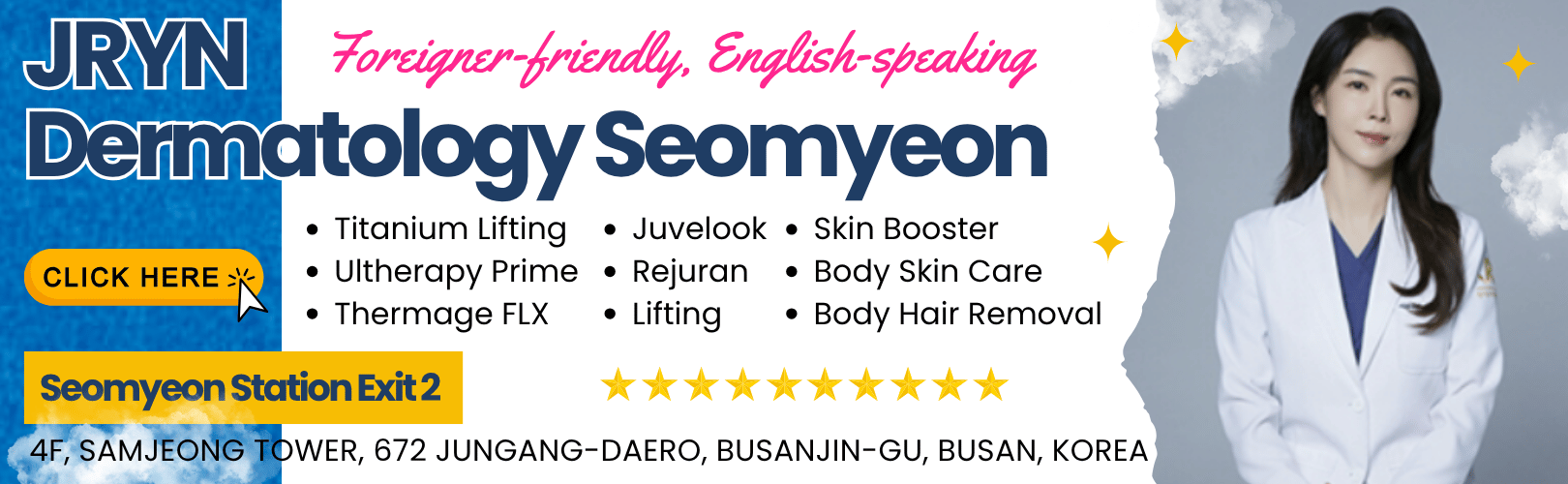
English-friendly support is available for international patients.
Seomyeon Location
JRYN Dermatology Clinic's Main Branch is centrally located in Busan.
Frequently Asked Questions
Where can I get jowls treatment in Busan?
JRYN Dermatology Clinic in Seomyeon provides non-surgical treatment options for jowls, lower-face sagging, and reduced jawline definition. Treatment may include HIFU, Ultherapy, RF skin tightening, or a customized approach depending on facial anatomy.
What is the best treatment for jowls?
There is no single best treatment for every patient. The appropriate option depends on whether the jowls are primarily caused by skin laxity, tissue changes, facial fat, volume distribution, or a combination of factors.
Can HIFU improve jowls?
HIFU may help selected patients with mild to moderate lower-face laxity by delivering focused ultrasound energy at selected tissue depths and stimulating a tightening response.
Can Ultherapy treat jowls?
Ultherapy may be used for selected patients concerned about lower-face, jawline, and neck laxity. Results generally develop progressively through collagen remodeling.
Does RF tightening help jowls?
RF skin tightening may improve firmness and mild laxity around the lower face by stimulating collagen remodeling.
Is RF or HIFU better for jowls?
Neither is universally better. HIFU and RF use different energy mechanisms and may be selected according to tissue depth, degree of laxity, skin condition, and treatment goals.
Can I treat jowls without filler?
Yes. Patients whose main concern is laxity may be candidates for energy-based treatments such as HIFU or RF without dermal filler.
Can jowls be treated without surgery?
Mild to moderate jowls may improve with non-surgical treatments. More advanced laxity may require a different approach, and non-surgical procedures cannot reproduce a surgical facelift.
Are jowls the same as a double chin?
No. Jowls generally develop along the sides of the jawline, while a double chin refers primarily to fullness underneath the chin.
Can jowls treatment improve my jawline?
When laxity contributes to poor jawline definition, tightening treatment may improve the contour. Other causes such as localized fat or facial anatomy may require a different strategy.
How long does it take to see results?
Results vary by treatment. Collagen-based tightening generally develops progressively over several weeks or months.
Can foreigners get jowls treatment in Busan?
Yes. JRYN Dermatology Clinic provides English support for international patients seeking non-surgical facial lifting and tightening treatments in Busan.
Visit JRYN Dermatology Clinic in Seomyeon, Busan
If you are concerned about jowls, lower-face sagging, or loss of jawline definition in Busan, JRYN Dermatology Clinic provides individualized consultation for non-surgical lifting and tightening treatments.
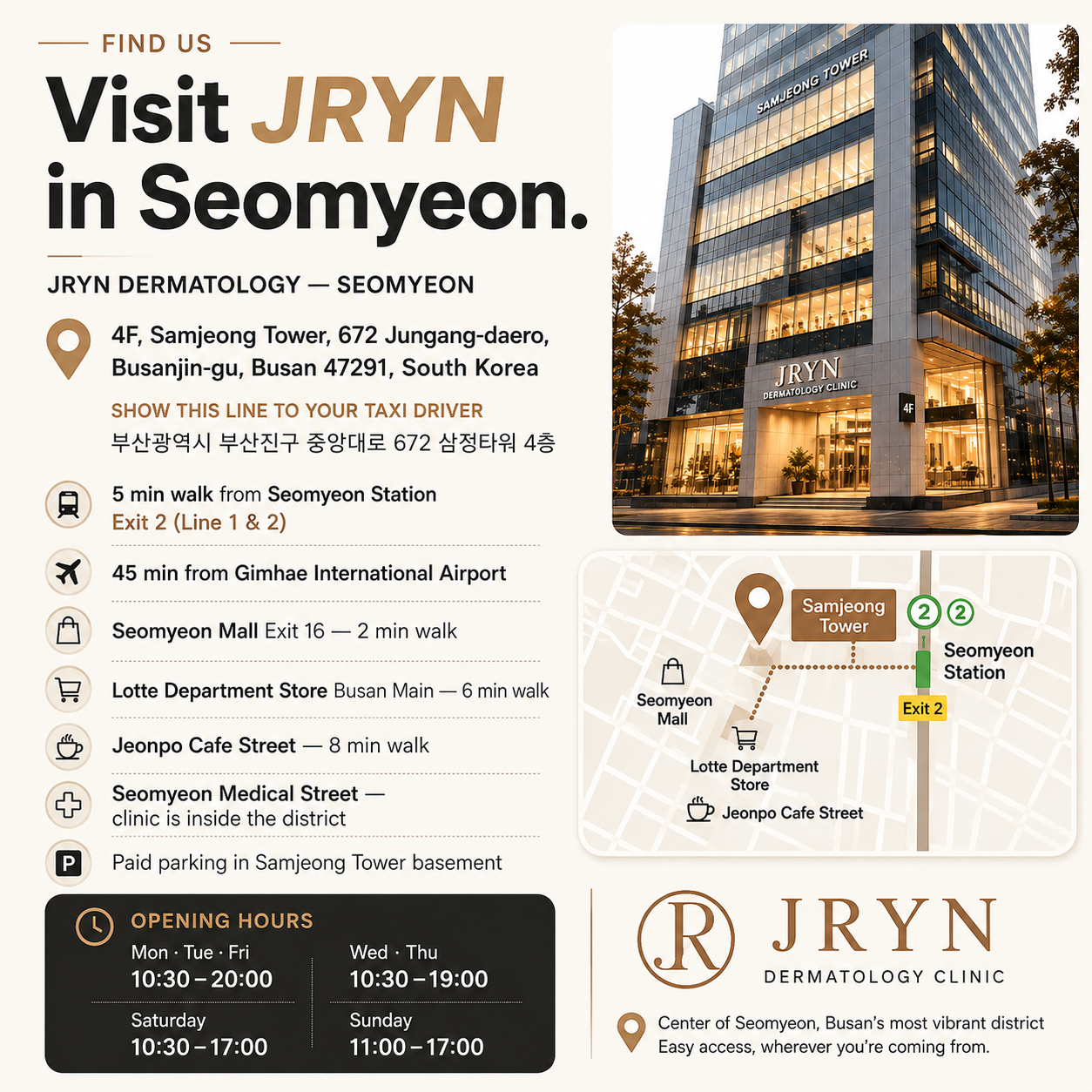
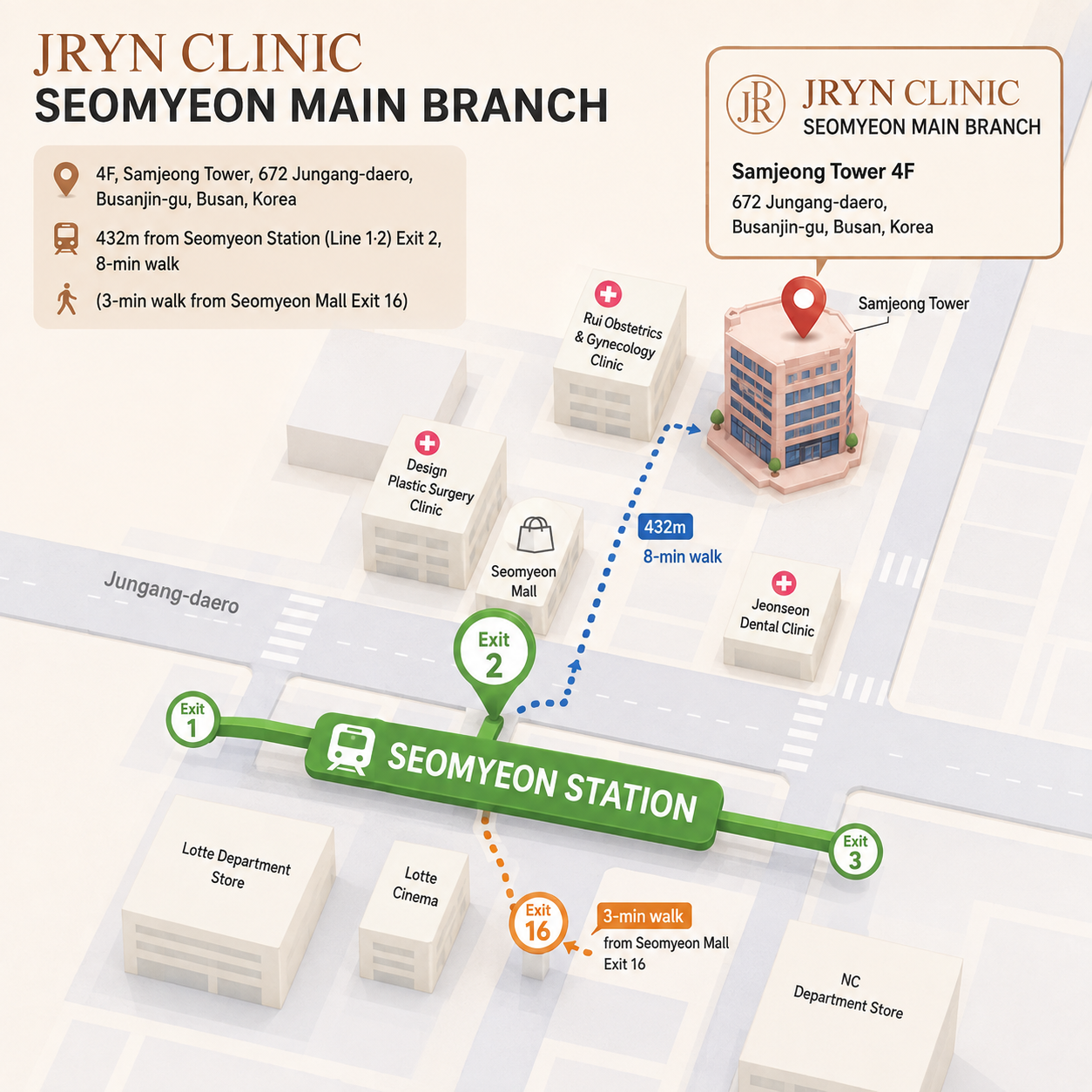
JRYN Dermatology Clinic – Seomyeon Main Branch
4F, Samjeong Tower
672 Jungang-daero
Busanjin-gu, Busan, Korea
English Support Available