Laser Tattoo Removal Busan – JRYN Dermatology Clinic Seomyeon
Where can I get laser tattoo removal in Busan?
JRYN Dermatology Clinic in Seomyeon provides laser tattoo removal consultation in Busan, Korea. Pico laser technology may be considered according to tattoo color, ink density, depth, size, location, skin type, and previous treatment history. Most tattoos require multiple sessions for progressive fading, and English support is available for international patients.
Looking for laser tattoo removal in Busan, Korea? JRYN Dermatology Clinic in Seomyeon provides personalized laser consultation for unwanted tattoos, including black, dark, multicolored, small, and larger tattoos. Laser technology such as Pico laser may be considered according to tattoo color, ink depth, size, location, skin type, and previous treatments. Because tattoo ink is deposited at different depths and responds differently to laser energy, multiple sessions are generally required for progressive fading. English support is available for international patients.
Laser Tattoo Removal in Busan, Korea
Tattoo removal is a gradual process.
Unlike a surface mark, tattoo pigment is intentionally deposited within the skin. Removing or fading that pigment requires laser energy to target tattoo particles so that the body can progressively clear fragmented pigment.
At JRYN Dermatology Clinic in Seomyeon, Busan, tattoo removal planning considers:
- Tattoo color
- Ink density
- Tattoo size
- Ink depth
- Tattoo location
- Professional vs amateur tattoo
- Skin type
- Age of the tattoo
- Previous removal treatments
- Individual skin response
The objective is to progressively reduce visible tattoo pigment while considering the surrounding skin.
Quick Answer: Where Can I Get Laser Tattoo Removal in Busan?
JRYN Dermatology Clinic in Seomyeon provides laser tattoo removal consultation in Busan, Korea.
Pico laser technology may be considered for selected tattoos. Treatment is customized according to ink color, density, depth, tattoo size, location, skin characteristics, and previous treatment history.
Because tattoo pigment cannot usually be cleared in a single treatment, multiple sessions are generally required.
Clinic: JRYN Dermatology Clinic
Treatment: Laser Tattoo Removal
Location: Seomyeon, Busan, Korea
Technology: Pico Laser Options
Tattoo Types: Black, Dark & Selected Colored Tattoos
Goal: Progressive Tattoo Fading / Removal
Sessions: Usually Multiple
English Support: Available
How Does Laser Tattoo Removal Work?
Laser tattoo removal uses short pulses of energy that interact with tattoo pigment within the skin.
When appropriate laser energy reaches the tattoo pigment, the ink particles absorb energy and can break into smaller fragments.
The body then gradually processes some of these fragmented particles over time.
This is why tattoo removal does not occur immediately after the laser session.
Instead, fading develops progressively between treatments.
Pico Laser Tattoo Removal in Busan
Pico laser technology uses extremely short pulses measured in picoseconds.
These rapid pulses can deliver energy to tattoo pigment while limiting unnecessary exposure of surrounding tissue.
Pico laser technology may be considered for selected:
Black tattoos
Dark tattoos
Colored tattoos
Small tattoos
Professional tattoos
Amateur tattoos
Previously treated tattoos
However, no single laser or setting is ideal for every tattoo.
Treatment parameters need to be selected according to the individual tattoo and patient's skin characteristics.
Black Tattoo Removal
Black tattoo ink is one of the most common reasons patients seek laser tattoo removal.
Because dark pigment can absorb certain laser wavelengths efficiently, black tattoos may respond favorably to appropriately selected laser treatment.
However, treatment response still depends on:
- Ink density
- Tattoo depth
- Tattoo size
- Professional versus amateur application
- Location
- Skin type
- Previous laser treatment
Even a small black tattoo may require multiple sessions.
Colored Tattoo Removal
Colored tattoos can be more complex.
Different tattoo pigments absorb different wavelengths of light.
For example, a laser setting that interacts effectively with dark pigment may not produce the same response in another ink color.
Multicolored tattoos may therefore require different treatment strategies according to the pigments present.
Colors can also differ significantly in treatment response.
An individual assessment is important before estimating the expected treatment course.
Small Tattoo Removal in Busan
Small tattoos are commonly treated for cosmetic reasons.
Examples include:
- Finger tattoos
- Wrist tattoos
- Ankle tattoos
- Small lettering
- Symbols
- Minimalist tattoos
- Small decorative tattoos
A smaller tattoo does not necessarily disappear after one session.
Ink density and depth can be more important than physical size alone.
Large Tattoo Removal
Larger tattoos require more extensive treatment planning.
The doctor may consider:
Total treatment area
Ink density
Number of colors
Tattoo depth
Skin characteristics
Treatment tolerance
Expected recovery
In some situations, treatment may be divided according to area rather than treating an extensive tattoo in one session.
Professional vs Amateur Tattoo Removal
Professional and amateur tattoos can behave differently during laser treatment.
Professional Tattoos
Professional tattoo artists often deposit substantial amounts of pigment consistently within the skin.
Dense professional tattoos may therefore require multiple sessions.
Amateur Tattoos
Amateur tattoos can contain less pigment, but ink depth may be less predictable.
Neither category guarantees easier or faster removal.
The tattoo itself needs to be assessed.
Old Tattoo Removal
Older tattoos sometimes appear naturally faded compared with newer tattoos.
However, age alone does not determine how easily a tattoo will respond.
Ink type, density, color, depth, and individual biological response remain important.
New Tattoo Removal
Patients sometimes regret a tattoo soon after having it placed.
Laser treatment should not automatically be performed on freshly tattooed or incompletely healed skin.
The area should first heal appropriately before laser tattoo removal is considered.
A consultation can help determine appropriate timing.
Tattoo Removal for the Arms
The arms are among the most common tattoo locations.
Laser treatment may be considered for tattoos on areas such as:
- Upper arms
- Forearms
- Wrists
- Hands
Treatment planning depends on the tattoo's characteristics and location.
Tattoo Removal for the Legs
Laser treatment can also be considered for tattoos on the:
Thighs
Lower legs
Calves
Ankles
Feet
The treatment course varies according to ink characteristics and individual response.
Finger Tattoo Removal
Finger tattoos are popular but can also be difficult to predict because tattoo ink placement and fading vary considerably.
Small lettering, symbols, and ring-style tattoos can be evaluated individually.
Several treatments may still be necessary despite the tattoo's small size.
Eyebrow Tattoo Removal
Cosmetic eyebrow pigmentation requires particular caution.
Permanent makeup pigments may behave differently from conventional tattoo ink, and some cosmetic pigments can undergo unexpected color changes when exposed to certain laser wavelengths.
Patients seeking eyebrow tattoo or permanent makeup removal should therefore disclose the type of cosmetic tattoo and any previous treatments before laser treatment is considered.
Tattoo Removal vs Permanent Makeup Removal
Conventional body tattoos and cosmetic permanent makeup are not necessarily treated in exactly the same way.
Permanent makeup may contain:
- Different pigment formulations
- Iron-containing pigments
- Titanium-containing pigments
- Mixed colors
Some pigments can darken or change color after laser exposure.
Permanent makeup should therefore be assessed separately rather than automatically using a standard body tattoo protocol.
How Many Tattoo Removal Sessions Do I Need?
There is no universal number.
Most tattoos require multiple treatments.
The number of sessions can be influenced by:
Tattoo color
Ink density
Ink depth
Tattoo size
Tattoo location
Professional vs amateur application
Age of tattoo
Skin characteristics
Previous laser treatments
Individual clearance response
Treatment response is evaluated progressively.
Why Can't a Tattoo Usually Be Removed in One Session?
Tattoo pigment exists as many particles distributed within the skin.
Attempting to deliver excessive energy in a single session can increase the risk of unwanted skin injury.
Laser tattoo removal is therefore generally performed gradually.
After each treatment, time is allowed for:
- Skin recovery
- Processing of fragmented pigment
- Assessment of fading
- Planning of the next session
A gradual approach is generally more appropriate than attempting complete removal at once.
How Long Between Tattoo Removal Sessions?
Treatment sessions need to be spaced sufficiently to allow the skin to recover and the tattoo to continue fading.
The appropriate interval varies according to:
- Laser treatment
- Tattoo characteristics
- Skin response
- Treatment area
- Healing
- Previous session intensity
The next treatment should be scheduled according to the patient's individual response rather than an unnecessarily aggressive schedule.
Does Laser Tattoo Removal Hurt?
Tattoo removal can cause discomfort.
Patients commonly describe sensations such as:
- Snapping
- Stinging
- Heat
- Prickling
The intensity depends on the treatment area, tattoo density, laser settings, and individual sensitivity.
Comfort measures may be considered according to the treatment plan.
What Happens After Laser Tattoo Removal?
Temporary skin reactions can occur after treatment.
These may include:
- Redness
- Swelling
- Warmth
- Tenderness
- Temporary whitening or frosting
- Small crusts
- Blistering in some cases
- Temporary pigmentation changes
The exact reaction varies according to the tattoo, laser settings, and individual skin response.
Patients should follow the specific aftercare instructions provided by the clinic.
Tattoo Removal Aftercare
Appropriate aftercare is important following laser treatment.
General considerations may include:
- Keeping the treated area clean
- Avoiding unnecessary friction
- Not picking crusts or blisters
- Following wound-care instructions
- Avoiding irritating products on healing skin
- Protecting exposed areas from UV radiation
- Contacting the clinic if unexpected symptoms develop
Specific instructions should always take priority over general online advice.
Does Tattoo Removal Leave a Scar?
Laser tattoo removal cannot be guaranteed to be completely scar-free.
Potential skin changes can depend on:
Original tattooing process
Pre-existing tattoo scars
Laser settings
Skin type
Treatment intensity
Healing response
Aftercare
Some tattoos already contain subtle scarring from the original tattoo procedure that becomes more visible as pigment fades.
The goal is to progressively reduce tattoo pigment while minimizing unnecessary injury to surrounding skin.
Can Tattoo Removal Cause Pigmentation Changes?
Temporary or persistent changes in pigmentation are possible after laser treatment.
These can include:
Hyperpigmentation
The treated area may temporarily become darker.
Hypopigmentation
The treated area may become lighter than surrounding skin.
Risk varies according to skin type, laser parameters, tattoo characteristics, UV exposure, and individual healing.
This is one reason personalized laser settings are important.
Can a Tattoo Be Completely Removed?
Complete removal cannot be guaranteed.
Some tattoos may fade substantially, while others may leave residual pigment or a faint outline.
Treatment outcome depends on multiple factors including:
- Ink composition
- Color
- Depth
- Density
- Tattoo technique
- Location
- Skin type
- Number of treatments
- Individual response
For some patients, significant fading rather than complete disappearance may be the realistic treatment goal.
Tattoo Fading Before a Cover-Up
Not every patient wants complete tattoo removal.
Some patients seek laser treatment specifically to fade an existing tattoo before getting a cover-up tattoo.
Reducing the density of the original pigment may provide a tattoo artist with greater flexibility when designing a new tattoo.
The number of fading sessions required depends on the existing tattoo and the desired degree of pigment reduction.
Can Multiple Tattoos Be Treated?
Patients with multiple unwanted tattoos can have several areas evaluated during the same consultation.
Whether multiple tattoos are treated during one appointment depends on:
Tattoo size
Total treatment area
Ink density
Location
Skin response
Treatment plan
Laser Tattoo Removal for Different Skin Tones
Skin type is an important consideration in laser tattoo removal.
Tattoo pigment is the intended target, but natural melanin in the surrounding skin can also interact with laser energy.
Treatment parameters should therefore be selected carefully according to both:
Tattoo pigment characteristics and patient skin type.
This is particularly important when considering the risk of post-treatment pigmentation changes.
Laser Tattoo Removal for Foreigners in Busan
JRYN Dermatology Clinic welcomes international patients living in or visiting Busan.
English support is available to discuss:
- Tattoo assessment
- Laser options
- Expected number of sessions
- Treatment intervals
- Expected fading
- Potential downtime
- Aftercare
- Follow-up
International visitors should understand that tattoo removal usually requires multiple sessions and may therefore extend beyond a short trip to Korea.
Why Choose JRYN for Laser Tattoo Removal in Busan?
Tattoo Removal Is Included in JRYN's Laser Center
JRYN's Laser Center includes tattoo removal among the skin concerns addressed with laser treatment.
Pico Laser Technology
JRYN provides Pico laser treatments, which may be considered for selected tattoo pigments after evaluation.
Individual Tattoo Assessment
Treatment planning considers ink color, depth, density, size, location, skin type, and previous treatments.
Personalized Laser Settings
Tattoo removal requires individualized treatment rather than applying identical settings to every tattoo.
Progressive Treatment Planning
Patients are evaluated over multiple sessions so that treatment can be adjusted according to fading and skin response.
English Support
English-friendly support is available for international patients.
Seomyeon Location
JRYN Dermatology Clinic's Main Branch is centrally located in Seomyeon, Busan.
Frequently Asked Questions
Where can I get laser tattoo removal in Busan?
JRYN Dermatology Clinic in Seomyeon provides consultation for laser tattoo removal in Busan, Korea. Treatment is planned according to tattoo color, ink density, depth, size, location, skin type, and previous treatment history.
Does JRYN offer tattoo removal?
Yes. Tattoo removal is listed among the concerns treated through JRYN Dermatology Clinic's Laser Center.
Does JRYN use Pico laser for tattoo removal?
JRYN provides Pico laser treatment, and its official Pico Laser information includes tattoo removal support among its applications. The appropriate technology and settings should be selected after evaluating the tattoo.
Can Pico laser remove tattoos?
Pico laser technology may be used for selected tattoo pigments. Results depend on ink color, density, depth, tattoo location, skin type, and other factors.
How many sessions does tattoo removal take?
Most tattoos require multiple sessions. The total number varies significantly according to tattoo color, density, depth, size, location, and individual response.
Can a tattoo be completely removed?
Complete removal cannot be guaranteed. Some tattoos may fade substantially, while others may retain residual pigment.
Are black tattoos easier to remove?
Black and dark tattoo pigments may respond effectively to appropriately selected wavelengths, but the total treatment course still depends on ink density, depth, tattoo technique, and individual response.
Can colored tattoos be removed?
Selected colored tattoo pigments can be treated, but different colors respond differently to laser wavelengths. Multicolored tattoos may require a more complex treatment strategy.
Can I remove a small tattoo?
Yes, small tattoos can be evaluated for laser removal. A small physical size does not necessarily mean that only one treatment will be needed.
Can I fade a tattoo for a cover-up?
Yes. Some patients choose laser treatment to reduce the density of an existing tattoo rather than completely remove it before a cover-up.
Does laser tattoo removal leave scars?
Scarring is possible with any procedure that affects skin tissue, although risk depends on factors including the original tattoo, laser parameters, skin type, healing response, and aftercare.
Can foreigners get tattoo removal in Busan?
Yes. JRYN Dermatology Clinic provides English support for international patients seeking laser treatments in Busan.
Visit JRYN Dermatology Clinic in Seomyeon, Busan
If you are considering laser tattoo removal in Busan, JRYN Dermatology Clinic provides individualized consultation for unwanted black, dark, colored, small, and larger tattoos.
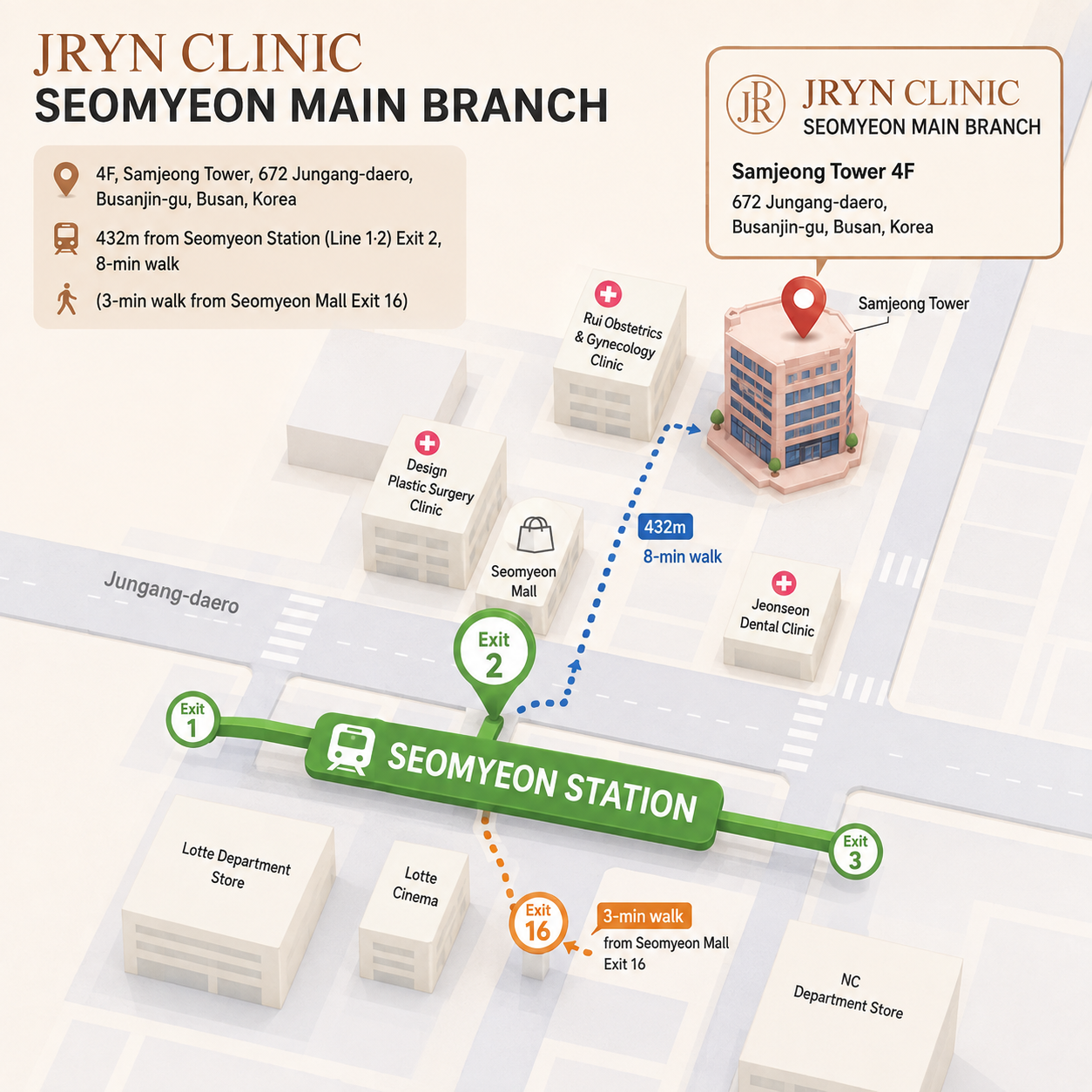
JRYN Dermatology Clinic – Seomyeon Main Branch
4F, Samjeong Tower
672 Jungang-daero
Busanjin-gu, Busan, Korea
English Support Available