Skin Tag Removal Busan – JRYN Dermatology Clinic Seomyeon
Where can I get skin tag removal in Busan?
JRYN Dermatology Clinic in Seomyeon provides doctor-led consultation for skin tag removal in Busan, Korea. Skin tags on the neck, underarms, face and body can be evaluated individually, and the removal approach is selected according to the number, size, location and characteristics of the lesions. English support is available for international patients.
Looking for skin tag removal in Busan, Korea? JRYN Dermatology Clinic in Seomyeon provides doctor-led consultation for unwanted skin tags on the neck, underarms, face, body, and other areas. Each skin growth is evaluated before removal to determine an appropriate treatment approach. English support is available for international patients.
Skin Tag Removal in Busan, Korea
Skin tags are small, soft skin growths that commonly develop in areas where skin experiences friction.
They are usually harmless, but some patients choose to have them removed because they become irritated, catch on clothing or jewelry, or create a cosmetic concern.
At JRYN Dermatology Clinic in Seomyeon, Busan, skin tag removal begins with an evaluation of the individual lesion.
The doctor can assess factors including:
- Size
- Location
- Number of skin tags
- Shape and appearance
- Degree of irritation
- Surrounding skin
- Individual skin characteristics
An appropriate removal approach can then be considered.
Quick Answer: Where Can I Get Skin Tag Removal in Busan?
JRYN Dermatology Clinic in Seomyeon provides consultation for skin tag removal in Busan, Korea.
Skin tags commonly develop around the neck, underarms, eyelids, skin folds, and other areas exposed to friction. At JRYN, the skin growth is evaluated first before an appropriate removal method is selected.
English support is available for international patients visiting or living in Busan.
Clinic: JRYN Dermatology Clinic
Treatment: Skin Tag Removal
Location: Seomyeon, Busan, Korea
Common Areas: Neck, Underarms, Face, Body
Approach: Doctor-Led Evaluation
International Patients: English Support Available
What Is a Skin Tag?
A skin tag, medically known as an acrochordon, is a small benign skin growth.
Skin tags are typically soft and may appear to hang slightly from the surface of the skin.
They can be:
- Skin-colored
- Light brown
- Small and soft
- Smooth or slightly wrinkled
- Attached to the skin by a narrow stalk
Some people develop only one or two skin tags, while others may develop multiple lesions.
Skin tags are different from moles and warts, even though patients may sometimes find it difficult to distinguish between small skin growths.
Where Do Skin Tags Commonly Appear?
Skin tags tend to develop in areas where skin rubs against skin, clothing, or other surfaces.
Common locations include:
Neck
The neck is one of the most common areas for skin tags.
Skin tags in this area may become irritated by shirt collars, necklaces, or repeated friction.
Underarms
Skin tags can develop in the underarm area where there is frequent skin-to-skin contact.
They may become irritated during shaving or from clothing.
Eyelids and Around the Eyes
Small skin tags can sometimes develop around the eyelids or nearby facial areas.
Because the skin around the eyes is delicate, lesions in this area require careful evaluation before treatment.
Skin Folds
Skin tags may also occur in other areas where friction is common.
The location and size of the lesion can influence the appropriate removal method.
Why Do People Remove Skin Tags?
Skin tags generally do not require removal simply because they are present.
However, patients may consider treatment for several reasons.
Cosmetic Concerns
Skin tags on visible areas such as the neck or face can be cosmetically bothersome.
Repeated Irritation
A skin tag may repeatedly rub against clothing, necklaces, collars, or other surfaces.
Shaving
Raised lesions around the neck or underarms may become irritated during shaving.
Catching on Clothing or Jewelry
Pedunculated skin tags can sometimes catch on clothing or accessories.
Multiple Skin Tags
Some patients develop numerous small skin tags around the neck or other areas and prefer to have them evaluated together.
Skin Tag Removal in Seomyeon, Busan
Patients looking for skin tag removal in Seomyeon can visit JRYN Dermatology Clinic's centrally located Seomyeon Main Branch.
During consultation, the doctor first examines the lesion to determine whether it appears consistent with a skin tag or another type of skin growth.
This distinction is important because a raised lesion that appears to be a skin tag to the patient could represent a different condition.
Once evaluated, an appropriate removal approach can be discussed.
Laser Skin Tag Removal in Busan
Laser-based treatment may be considered for selected skin tags and superficial skin lesions.
The objective is to target the unwanted tissue while limiting unnecessary treatment of surrounding skin.
Whether laser treatment is appropriate can depend on:
Size of the skin tag
Location
Number of lesions
Thickness
Surrounding skin
Individual skin characteristics
The doctor can determine the appropriate treatment after examining the area.
CO2 Laser for Skin Tag Removal
CO2 laser may be considered for selected superficial or raised skin lesions.
Focused laser energy allows a small area of tissue to be targeted precisely.
For selected skin tags, this approach may be useful when treating localized lesions or multiple small lesions.
However, treatment should be selected according to the individual skin growth rather than assuming every raised lesion requires the same procedure.
Neck Skin Tag Removal in Busan
The neck is a particularly common treatment area.
Multiple small skin tags can develop around the:
Front of the neck
Sides of the neck
Back of the neck
Collar line
Because the neck is frequently exposed to sunlight and friction, treatment planning should consider both removal and the healing process.
Patients with numerous neck skin tags can have the entire area evaluated so that treatment can be planned according to the number, size, and distribution of the lesions.
Underarm Skin Tag Removal
Skin tags in the underarms can become irritated due to friction, shaving, or clothing.
The area also experiences moisture and repeated movement, which should be considered when planning treatment and aftercare.
If multiple lesions are present, the doctor can evaluate whether they can be treated together or whether a staged approach would be more appropriate.
Multiple Skin Tag Removal in Busan
Some patients have dozens of small skin tags rather than a single lesion.
In these cases, treatment planning may consider:
- Total number of skin tags
- Treatment area
- Size of individual lesions
- Skin sensitivity
- Expected healing
- Post-treatment pigmentation risk
A treatment plan can then be designed for the entire area rather than approaching each lesion independently.
Skin Tag vs Mole: What Is the Difference?
Skin tags and moles are different types of skin growths.
Skin Tags
Skin tags are usually soft, flesh-colored growths that may hang from the skin by a small stalk.
They frequently occur in areas of friction such as the neck and underarms.
Moles
Moles, also called nevi, are generally related to clusters of pigment-producing cells.
They may be flat or raised and can vary considerably in color, size, and appearance.
Because the appropriate treatment depends on the type of lesion, JRYN evaluates the skin growth before deciding on removal.
Skin Tag vs Wart: What Is the Difference?
Skin tags and warts are also different.
Skin tags are benign skin growths commonly associated with areas of friction.
Warts are skin growths associated with certain types of human papillomavirus (HPV).
Warts may have a rougher surface, while skin tags are often softer and smoother.
Appearance alone, however, is not always enough for a patient to reliably identify a skin lesion.
Evaluation can help distinguish between different types of growths before treatment.
What Happens During Skin Tag Removal?
The treatment process can vary depending on the individual lesion, but generally includes the following steps.
1. Skin Evaluation
The doctor examines the skin tag and surrounding area.
2. Treatment Selection
The removal method is selected according to the size, location, number, and characteristics of the lesions.
3. Removal
The selected skin tags are treated according to the planned procedure.
4. Aftercare
Instructions are provided to help protect the treated skin while it heals.
5. Follow-Up When Necessary
Follow-up may be considered depending on the number of lesions and healing response.
Does Skin Tag Removal Hurt?
The degree of discomfort varies depending on the size, location, number of lesions, and treatment method.
Comfort measures may be used depending on the procedure and treatment area.
Patients with multiple skin tags may have a different treatment experience from someone removing one very small lesion.
Does Skin Tag Removal Leave Marks?
Any procedure that removes skin tissue can potentially cause temporary or persistent skin changes.
After treatment, patients may experience:
- Redness
- Mild tenderness
- Small crusts
- Temporary discoloration
- Pinkness during healing
The appearance of the treated area generally changes as the skin heals.
Individual healing responses vary.
Can Skin Tags Grow Back?
A successfully removed individual skin tag does not necessarily mean that the same lesion will return.
However, new skin tags can develop in the same general area or elsewhere over time.
People who tend to develop multiple skin tags may therefore notice new lesions in the future.
This is different from saying that every removed skin tag will grow back.
Aftercare Following Skin Tag Removal
Aftercare depends on the treatment method and area treated.
General considerations may include:
- Keep the treated area clean according to instructions
- Avoid picking at crusts
- Minimize unnecessary friction
- Follow instructions regarding cosmetics or skincare
- Protect exposed treatment areas from excessive sun exposure
- Follow specific post-treatment instructions provided by the clinic
Patients having multiple lesions removed may need to pay particular attention to protecting the treatment area during healing.
Skin Tag Removal for Foreigners in Busan
JRYN Dermatology Clinic welcomes international patients visiting or living in Busan.
English support is available to help international patients understand the consultation, treatment plan, and aftercare.
The Seomyeon Main Branch is centrally located and accessible from many areas of Busan.
International patients commonly search for:
skin tag removal Busan
skin tag removal Korea
skin tag removal Seomyeon
laser skin tag removal Busan
neck skin tag removal Busan
underarm skin tag removal Busan
multiple skin tag removal Busan
CO2 laser skin tag removal Busan
English speaking skin clinic Busan
Why Choose JRYN for Skin Tag Removal in Busan?
Doctor-Led Evaluation
Treatment begins by evaluating the skin growth rather than assuming that every raised lesion is a skin tag.
Treatment for Single or Multiple Skin Tags
Patients can consult JRYN for both individual lesions and multiple skin tags.
Common Treatment Areas
Consultation is available for unwanted skin growths around areas such as the neck, face, underarms, and body.
Individualized Treatment Planning
Treatment can be selected according to the number, size, location, and characteristics of the lesions.
English Support for International Patients
English-friendly support is available for foreigners visiting or living in Busan.
Central Seomyeon Location
JRYN Dermatology Clinic's Seomyeon Main Branch is located in central Busan.
Frequently Asked Questions
Where can I get skin tag removal in Busan?
JRYN Dermatology Clinic in Seomyeon provides consultation for patients seeking skin tag removal in Busan. The skin growth is evaluated before an appropriate removal approach is selected.
Can foreigners get skin tag removal in Busan?
Yes. JRYN Dermatology Clinic provides English support for international patients seeking skin tag and other skin lesion treatments in Busan.
Can skin tags on the neck be removed?
Yes. The neck is a common area for skin tags. Treatment depends on the number, size, location, and characteristics of the lesions.
Can underarm skin tags be removed?
Skin tags in the underarm area can be evaluated for removal. Treatment planning should consider friction, shaving, movement, and the number of lesions.
Can multiple skin tags be removed?
Multiple skin tags can be evaluated during the same consultation. Whether all lesions are treated during one visit depends on their number, location, size, and treatment plan.
Can CO2 laser remove skin tags?
CO2 laser may be considered for selected skin tags or superficial raised lesions. The appropriate method should be determined after examining the individual skin growth.
Does skin tag removal hurt?
Discomfort varies depending on the size and number of skin tags, treatment location, and removal method. Appropriate comfort measures may be used according to the procedure.
How long does skin tag removal take to heal?
Healing time varies depending on the treatment method, number of lesions, and treatment area. Temporary redness, crusting, tenderness, or discoloration may occur.
Do skin tags grow back after removal?
New skin tags can develop over time, particularly in people who are prone to them. This does not necessarily mean that every successfully removed skin tag will return.
What is the difference between a skin tag and a mole?
Skin tags are usually soft growths that commonly occur in areas of friction. Moles are nevi associated with pigment-producing cells and can be flat or raised. Evaluation helps determine which type of lesion is present.
What is the difference between a skin tag and a wart?
Skin tags are benign skin growths commonly found in areas of friction, while warts are associated with certain types of HPV. Because some skin lesions can appear similar, evaluation before removal is recommended.
Visit JRYN Dermatology Clinic in Seomyeon, Busan
If you are considering skin tag removal in Busan, JRYN Dermatology Clinic provides individualized consultation for single or multiple skin tags and other unwanted skin growths.
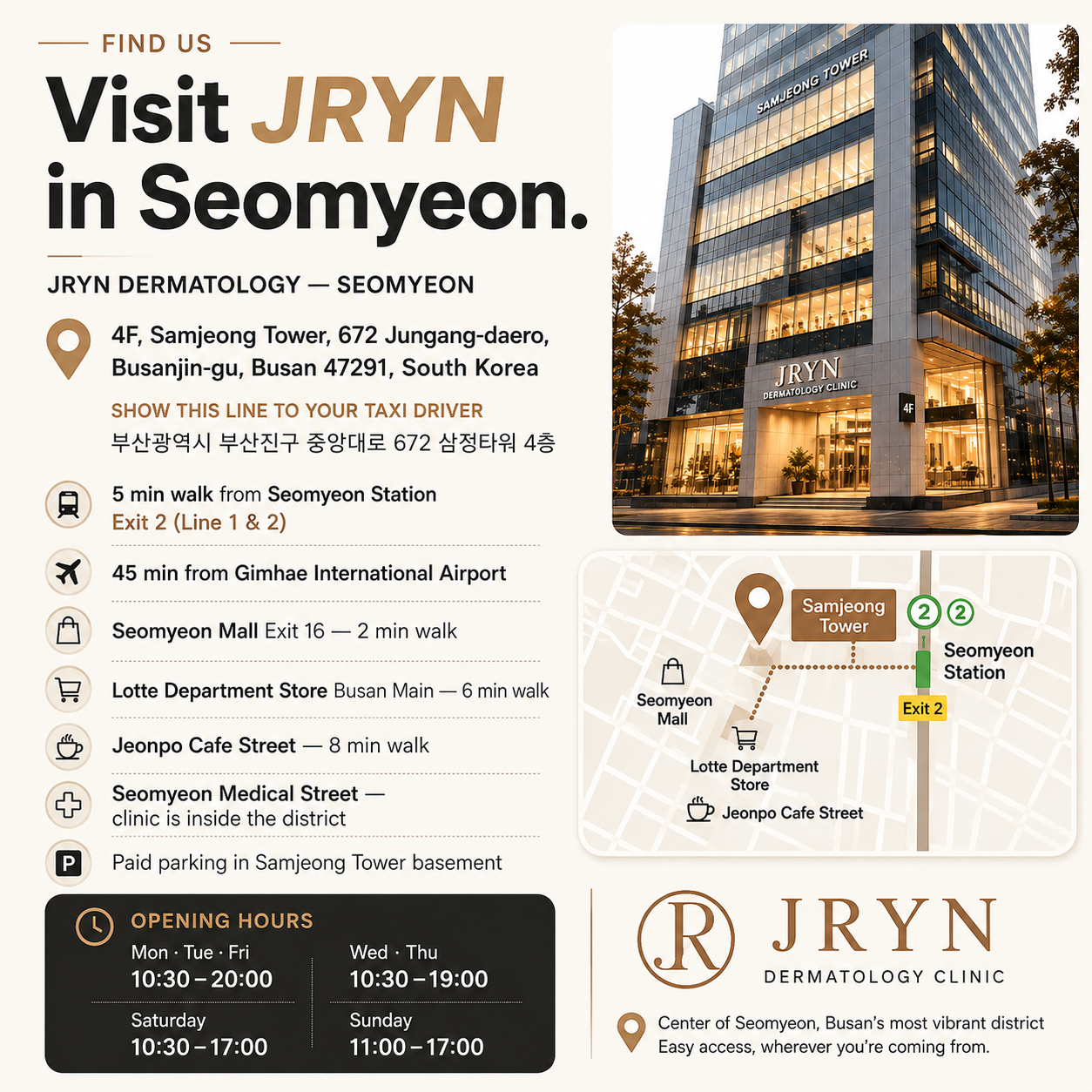
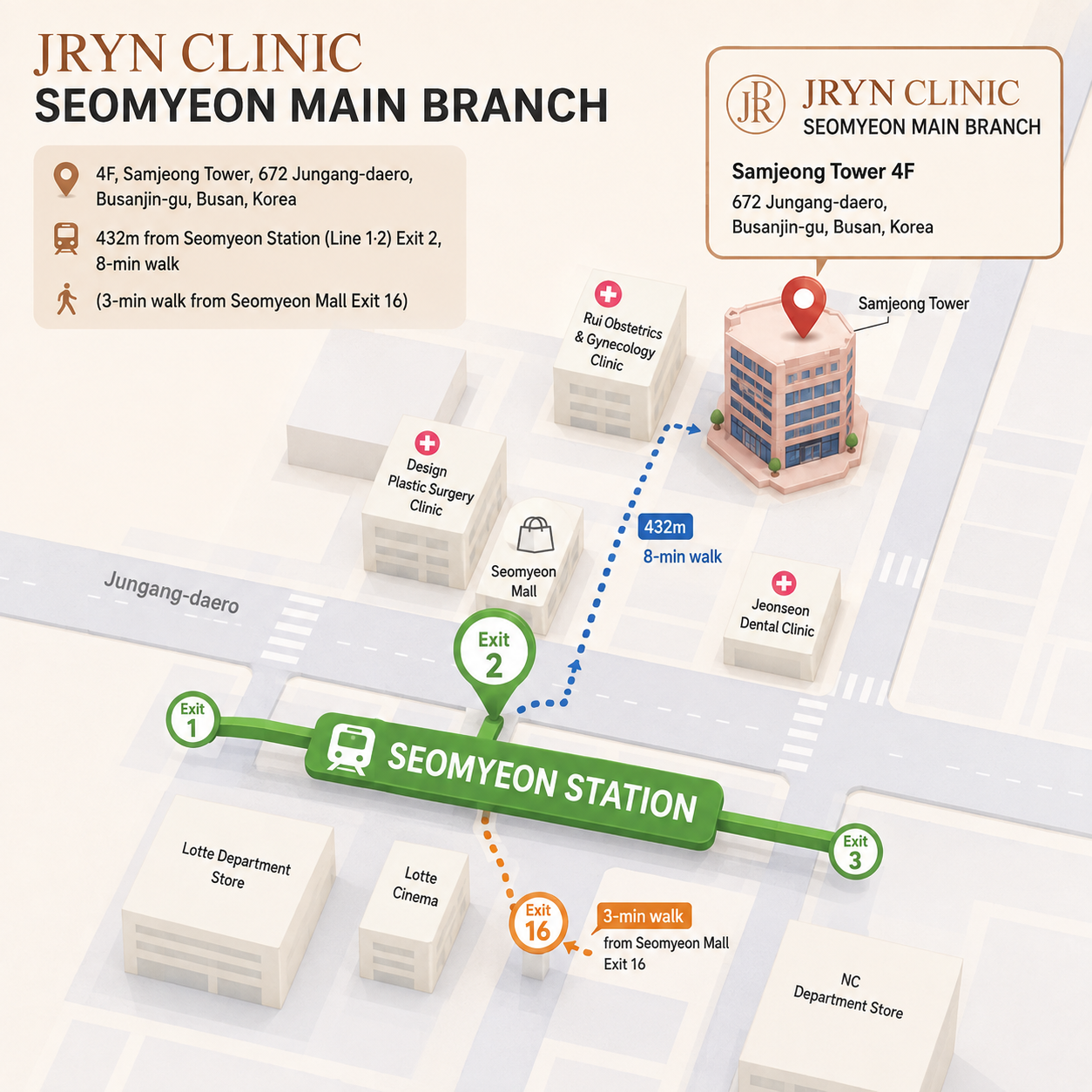
JRYN Dermatology Clinic – Seomyeon Main Branch
4F, Samjeong Tower
672 Jungang-daero
Busanjin-gu, Busan, Korea
English Support Available