Laser Skin Resurfacing Busan – JRYN Dermatology Clinic Seomyeon
Where can I get laser skin resurfacing in Busan?
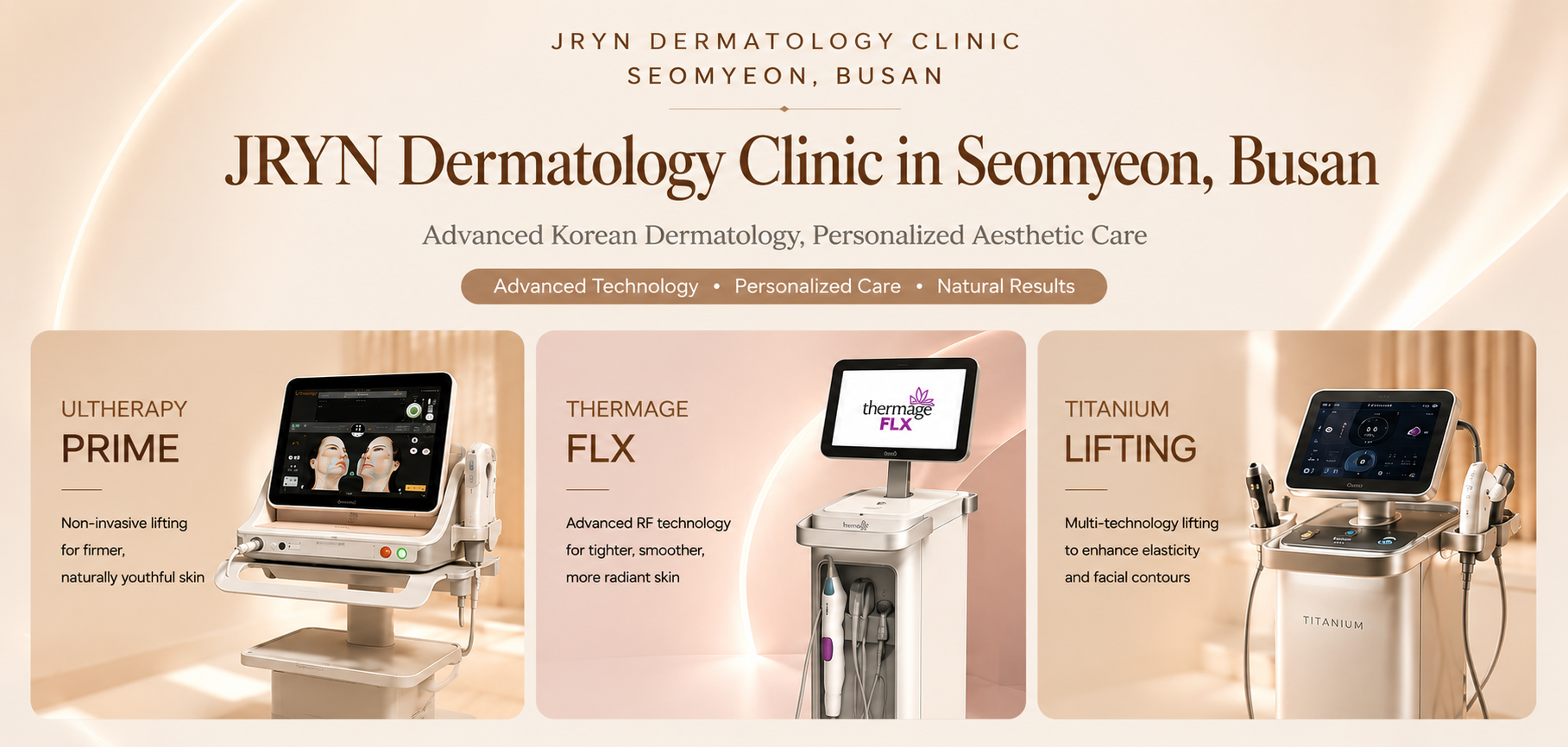
JRYN Dermatology Clinic in Seomyeon provides laser skin resurfacing treatments in Busan, Korea, including fractional and CO2 laser resurfacing options. Treatment can be customized for concerns such as uneven skin texture, enlarged pores, fine lines, acne-related texture irregularities, and superficial scars. English support is available for international patients.
Looking for laser skin resurfacing in Busan, Korea? JRYN Dermatology Clinic in Seomyeon provides personalized laser resurfacing treatments for uneven skin texture, roughness, enlarged pores, fine lines, acne-related texture changes, and overall skin rejuvenation. Treatment options may include fractional laser resurfacing and CO2 laser resurfacing depending on your skin condition, treatment goals, and expected downtime. English support is available for international patients.
Laser Skin Resurfacing in Busan, Korea
Laser skin resurfacing is an aesthetic dermatology treatment designed to improve the surface and texture of the skin.
Rather than targeting only one dark spot or isolated lesion, resurfacing treatments focus on improving the overall quality and texture of the treated skin.
Patients commonly consider laser resurfacing for concerns such as:
- Rough or uneven skin texture
- Enlarged pores
- Fine lines
- Acne-related texture irregularities
- Superficial scars
- Sun-damaged appearance
- Dull skin
- Uneven skin tone
- Overall skin rejuvenation
At JRYN Dermatology Clinic in Seomyeon, Busan, the treatment approach is selected after evaluating the patient's skin condition, sensitivity, concerns, and desired level of recovery.
Quick Answer: Where Can I Get Laser Skin Resurfacing in Busan?
JRYN Dermatology Clinic in Seomyeon provides laser skin resurfacing treatments in Busan, Korea, including fractional and CO2 laser resurfacing options.
Treatment is customized according to skin texture, pores, scars, fine lines, pigmentation, skin sensitivity, and desired downtime.
Clinic: JRYN Dermatology Clinic
Treatment: Laser Skin Resurfacing
Location: Seomyeon, Busan, Korea
Options: Fractional Laser / CO2 Laser Resurfacing
Common Concerns: Texture, Pores, Fine Lines, Scars, Rough Skin
Approach: Personalized Treatment Planning
English Support: Available
What Is Laser Skin Resurfacing?
Laser skin resurfacing uses controlled laser energy to treat selected layers or microscopic areas of the skin.
Depending on the laser technology and treatment settings, resurfacing may remove or remodel portions of damaged skin while stimulating the skin's natural repair response.
This process can support:
Smoother skin texture
Collagen remodeling
Improved appearance of pores
Reduction of superficial irregularities
Improvement in fine lines
More even-looking skin
Different resurfacing technologies work at different depths and intensities.
This is why treatment should be selected according to the patient's individual skin condition rather than using the same laser settings for everyone.
What Can Laser Skin Resurfacing Treat?
Uneven Skin Texture
One of the primary reasons patients choose laser resurfacing is to improve rough or uneven skin.
Texture irregularities can develop because of aging, acne, sun exposure, previous inflammation, or changes in collagen structure.
Resurfacing treatment aims to create a smoother and more refined appearance.
Enlarged Pores
Enlarged pores are influenced by several factors, including oil production, skin elasticity, acne history, and genetics.
Laser resurfacing may help improve the appearance of enlarged pores by supporting collagen remodeling and improving surrounding skin texture.
Pores cannot literally be permanently erased, so treatment goals should focus on visible refinement rather than complete elimination.
Fine Lines
As collagen and elastin change with age, fine lines can become more visible.
Fractional resurfacing treatments may stimulate a controlled healing response and collagen remodeling, helping improve the appearance of selected fine lines and textural aging.
Acne-Related Texture
Previous acne can leave irregular skin texture even after active breakouts have improved.
Depending on the type and depth of the irregularity, fractional resurfacing may form part of a customized treatment strategy.
Deeper acne scars may require a dedicated acne scar treatment plan or combination therapy rather than resurfacing alone.
Rough or Dull Skin
Accumulated surface irregularities and changes in skin turnover can make the complexion appear rough or dull.
Selected resurfacing procedures may improve surface smoothness and support a fresher-looking complexion.
Superficial Scars
Some superficial scars may respond to resurfacing treatment.
However, scar morphology matters.
Rolling, boxcar, ice-pick, surgical, and other scar types may require different treatment strategies.
The scar should therefore be evaluated before deciding whether laser resurfacing is appropriate.
Fractional Laser Resurfacing in Busan
Fractional laser resurfacing treats the skin through many microscopic treatment zones rather than uniformly treating the entire surface.
Areas of untreated skin remain between the microscopic treatment columns.
This fractional approach is designed to stimulate skin renewal and collagen remodeling while allowing surrounding tissue to participate in the healing process.
Fractional resurfacing may be considered for:
- Uneven texture
- Enlarged pores
- Fine lines
- Selected acne scars
- Rough skin
- Photoaging
- Overall skin rejuvenation
Treatment intensity can vary considerably depending on the technology and settings used.
CO2 Laser Resurfacing in Busan
CO2 laser resurfacing is a more intensive resurfacing option that uses carbon dioxide laser energy to target water-containing skin tissue.
Depending on treatment settings, CO2 laser technology can be used to create controlled resurfacing and stimulate tissue remodeling.
Patients may consider CO2 resurfacing for concerns such as:
Pronounced skin texture irregularities
Selected acne scars
Fine lines and wrinkles
Photoaged skin
Rough skin texture
Selected superficial skin irregularities
Because CO2 resurfacing can involve more significant skin disruption than gentler laser treatments, recovery and aftercare are important considerations.
Not every patient needs aggressive resurfacing.
The appropriate intensity should be selected according to skin condition, treatment goals, skin type, and acceptable downtime.
Fractional Laser vs CO2 Laser Resurfacing
These terms are sometimes used interchangeably, but they do not necessarily mean exactly the same thing.
Fractional Laser
"Fractional" describes the way laser energy is delivered in microscopic treatment zones.
Different types of lasers can use fractional technology.
CO2 Laser
CO2 describes a specific laser wavelength and technology.
A CO2 laser can also be delivered fractionally.
Therefore, a patient may receive fractional CO2 laser resurfacing.
The appropriate technology depends on the skin concern and desired treatment intensity.
Laser Resurfacing for Acne Scars
Laser resurfacing is frequently considered by patients with acne scars, but acne scars are not all identical.
Different scar patterns can include:
- Rolling scars
- Boxcar scars
- Ice-pick scars
- Superficial textural scars
- Mixed acne scars
Some scars may respond better to fractional resurfacing, while others may require different or combination approaches.
At JRYN, patients with acne-related texture concerns can have their skin evaluated before a treatment strategy is selected.
Laser Resurfacing for Enlarged Pores
Patients with visible pores often search for resurfacing treatments because pore appearance is closely related to surrounding skin texture and elasticity.
Laser resurfacing may help create a smoother appearance by supporting collagen remodeling around the treated areas.
However, pore size is influenced by genetics, sebaceous activity, age, and skin condition.
For this reason, realistic treatment goals are important.
Laser Resurfacing for Fine Lines
Fine lines caused by photoaging and changes in collagen may become more noticeable around areas such as the:
Cheeks
Forehead
Around the mouth
Lower face
Fractional resurfacing can be considered when the goal is to improve both texture and fine lines.
Deeper wrinkles or facial volume loss may require a different treatment strategy.
Laser Resurfacing vs Laser Toning
Laser resurfacing and laser toning have different primary treatment objectives.
Laser Skin Resurfacing
Primarily focuses on:
- Skin texture
- Surface irregularities
- Pores
- Fine lines
- Selected scars
- Collagen remodeling
Laser Toning
Primarily focuses on selected pigmentation and overall tone concerns.
A patient concerned mainly about uneven texture may therefore require a different laser strategy from someone primarily concerned about pigmentation.
Laser Resurfacing vs Pico Laser
Pico lasers use extremely short pulses of laser energy and are commonly associated with selected pigmentation, tattoo, and skin rejuvenation applications.
Laser resurfacing focuses more directly on skin texture remodeling and controlled renewal.
Depending on the patient's concerns, different technologies may be used separately or incorporated into a broader treatment plan.
Laser Resurfacing vs Microneedling
Both treatments can be used to address texture and support collagen remodeling, but they work differently.
Laser Resurfacing
Uses controlled laser energy to treat selected layers or microscopic zones of skin.
Microneedling
Uses fine needles to create controlled micro-injuries that stimulate the skin's repair response.
Treatment selection depends on skin type, concern, scar pattern, desired intensity, and acceptable downtime.
Laser Resurfacing vs RF Microneedling
RF microneedling combines microneedles with radiofrequency energy delivered into selected depths of the skin.
Laser resurfacing uses laser energy rather than RF energy.
Both may be considered for texture and acne-related concerns, but they interact with tissue differently.
In some cases, combination treatment may be considered after individual assessment.
What Happens During Laser Skin Resurfacing?
1. Skin Consultation
The skin is evaluated for texture, scars, pores, pigmentation, sensitivity, and other concerns.
2. Treatment Selection
The doctor determines which laser approach and treatment intensity may be suitable.
3. Skin Preparation
The treatment area is prepared according to the selected procedure.
4. Laser Treatment
Laser energy is delivered according to the treatment plan.
5. Post-Laser Care
Appropriate cooling, skincare, or recovery instructions may be provided.
6. Recovery
The skin enters a healing and remodeling phase following treatment.
Does Laser Skin Resurfacing Hurt?
Treatment sensation varies considerably depending on the laser technology and intensity.
Patients may experience sensations such as:
- Heat
- Prickling
- Stinging
- Warmth
Comfort measures may be used depending on the resurfacing procedure.
More intensive resurfacing generally requires greater consideration of comfort and recovery than very gentle laser treatments.
How Much Downtime Is There?
Downtime depends heavily on the treatment technology and intensity.
A lighter fractional treatment may produce temporary redness or sensitivity.
More intensive resurfacing may cause:
- Redness
- Swelling
- Dryness
- Flaking
- Crusting
- Temporary darkening
- Increased skin sensitivity
Recovery should therefore be discussed before treatment, particularly for international visitors with limited time in Korea.
Aftercare Following Laser Resurfacing
Proper aftercare is an important part of resurfacing treatment.
Patients should follow their individual post-treatment instructions.
General considerations may include:
- Gentle cleansing
- Appropriate moisturization
- Avoiding picking or scratching
- Avoiding unnecessary exfoliation
- Temporarily avoiding irritating active skincare ingredients
- Consistent sun protection
- Following instructions regarding makeup
- Avoiding excessive heat or friction during early recovery
The exact aftercare protocol depends on treatment intensity.
When Will I See Results?
Skin appearance changes gradually as the treated area heals and remodeling progresses.
Some surface changes may become noticeable after initial recovery, while collagen-related improvements can develop progressively.
The timeline depends on:
Laser technology
Treatment intensity
Skin concern
Age
Skin condition
Healing response
Number of treatments
Results should therefore be evaluated over time rather than immediately after the procedure.
How Many Laser Resurfacing Sessions Do I Need?
There is no universal number of sessions.
A patient receiving a stronger resurfacing treatment may follow a different schedule from someone receiving a series of lower-intensity fractional treatments.
The treatment plan depends on:
- Severity of texture concerns
- Scar depth
- Pore appearance
- Skin type
- Laser technology
- Treatment intensity
- Desired downtime
- Individual response
A personalized consultation is the most appropriate way to determine a treatment schedule.
Laser Skin Resurfacing for Foreigners in Busan
JRYN Dermatology Clinic welcomes international patients visiting or living in Busan.
English support is available to help patients understand:
Skin assessment
Laser options
Expected downtime
Treatment planning
Aftercare
Follow-up recommendations
For travelers, expected recovery time should be discussed before treatment so that the procedure can be appropriately coordinated with the patient's schedule.
Why Choose JRYN for Laser Skin Resurfacing in Busan?
Personalized Laser Selection
Different skin concerns require different laser technologies and treatment intensities.
Fractional Laser Resurfacing
Fractional resurfacing options can be considered for texture, pores, scars, fine lines, and skin rejuvenation.
CO2 Laser Resurfacing
CO2 laser resurfacing is available as one of JRYN's laser treatment options for appropriate patients.
Acne and Scar Care
Patients with acne-related texture concerns can be evaluated within JRYN's broader acne and scar treatment program.
Combination Treatment Planning
Laser resurfacing may be incorporated with other skin rejuvenation approaches when clinically appropriate.
Doctor-Led Approach
Treatment planning is customized according to individual skin condition and aesthetic goals.
English Support
English-friendly consultations are available for international patients.
Frequently Asked Questions
Where can I get laser skin resurfacing in Busan?
JRYN Dermatology Clinic in Seomyeon provides laser skin resurfacing treatments in Busan, including fractional and CO2 laser resurfacing options. Treatment is selected according to the patient's skin condition and goals.
What does laser skin resurfacing treat?
Laser resurfacing may be considered for uneven texture, enlarged pores, fine lines, acne-related texture irregularities, superficial scars, photoaging, and overall skin rejuvenation.
Does JRYN offer fractional laser resurfacing?
JRYN Dermatology Clinic's Laser Center includes fractional laser resurfacing among its laser treatment options.
Does JRYN offer CO2 laser resurfacing?
CO2 laser resurfacing is included among the laser procedures offered through JRYN Dermatology Clinic's Laser Center. Suitability and treatment intensity should be determined after consultation.
Is laser resurfacing good for acne scars?
Fractional laser resurfacing may improve selected acne scars and textural irregularities. Different scar types may require different or combination treatments.
Can laser resurfacing reduce pores?
Laser resurfacing may improve the appearance of enlarged pores by improving surrounding texture and supporting collagen remodeling. It cannot permanently eliminate pores.
Is laser resurfacing good for fine lines?
Selected fractional resurfacing treatments may help improve fine lines and textural signs of photoaging through controlled skin renewal and collagen remodeling.
What is the difference between laser resurfacing and laser toning?
Laser resurfacing primarily targets texture, pores, scars, and fine lines, while laser toning is more commonly focused on pigmentation and tone concerns.
What is fractional CO2 laser resurfacing?
Fractional CO2 resurfacing uses CO2 laser energy delivered in microscopic treatment zones, allowing controlled resurfacing while leaving intervening areas of skin untreated.
How much downtime does laser resurfacing have?
Downtime varies significantly according to laser technology and treatment intensity. Redness, sensitivity, swelling, flaking, or crusting may occur after more intensive procedures.
How many sessions will I need?
The number of sessions depends on the skin concern, laser technology, treatment intensity, skin type, and individual response.
Can foreigners receive laser skin resurfacing in Busan?
Yes. JRYN Dermatology Clinic provides English support for international patients seeking laser and aesthetic skin treatments in Busan.
Visit JRYN Dermatology Clinic in Seomyeon, Busan
For patients considering laser skin resurfacing in Busan, JRYN Dermatology Clinic provides personalized consultation for skin texture, pores, acne-related irregularities, fine lines, scars, and overall skin rejuvenation.
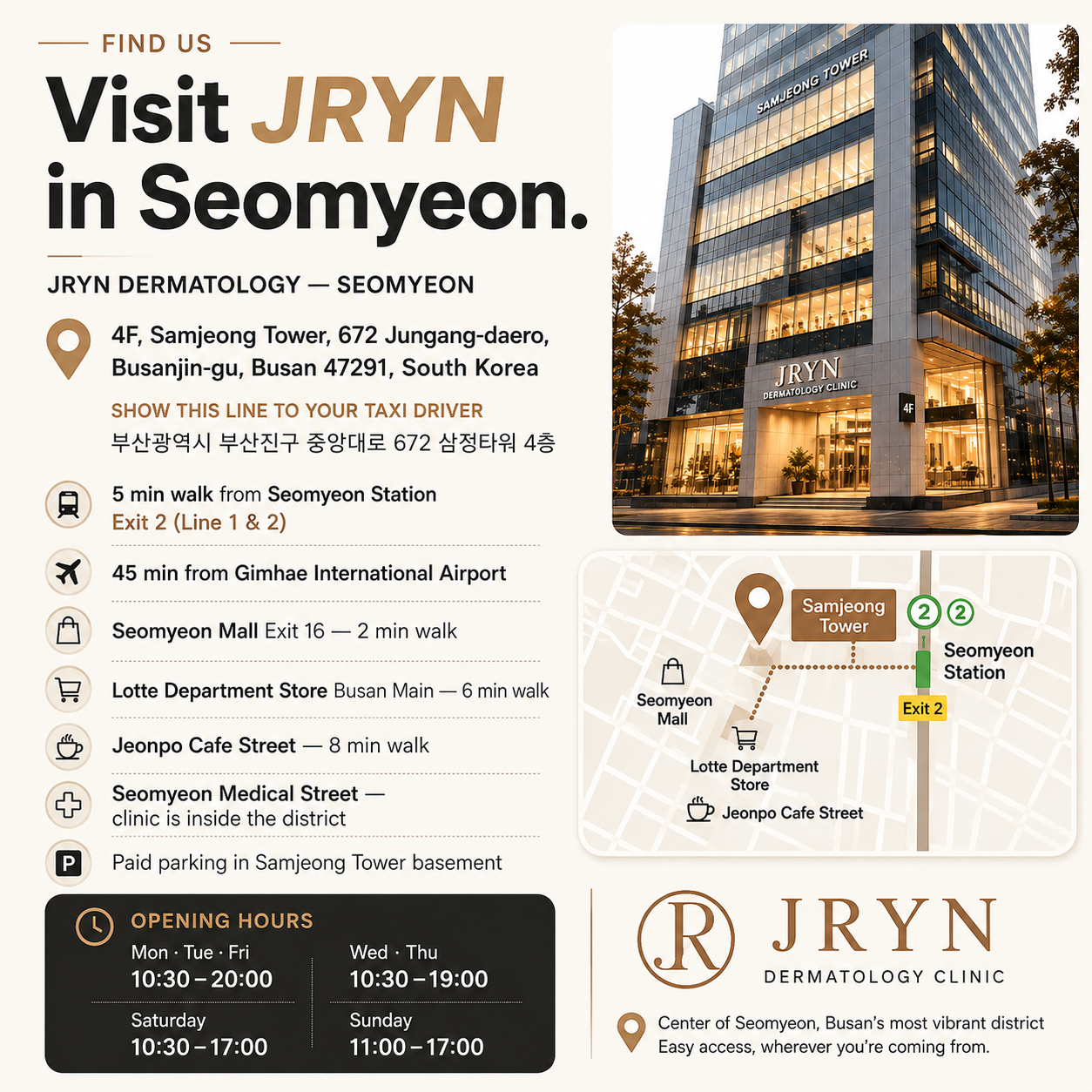
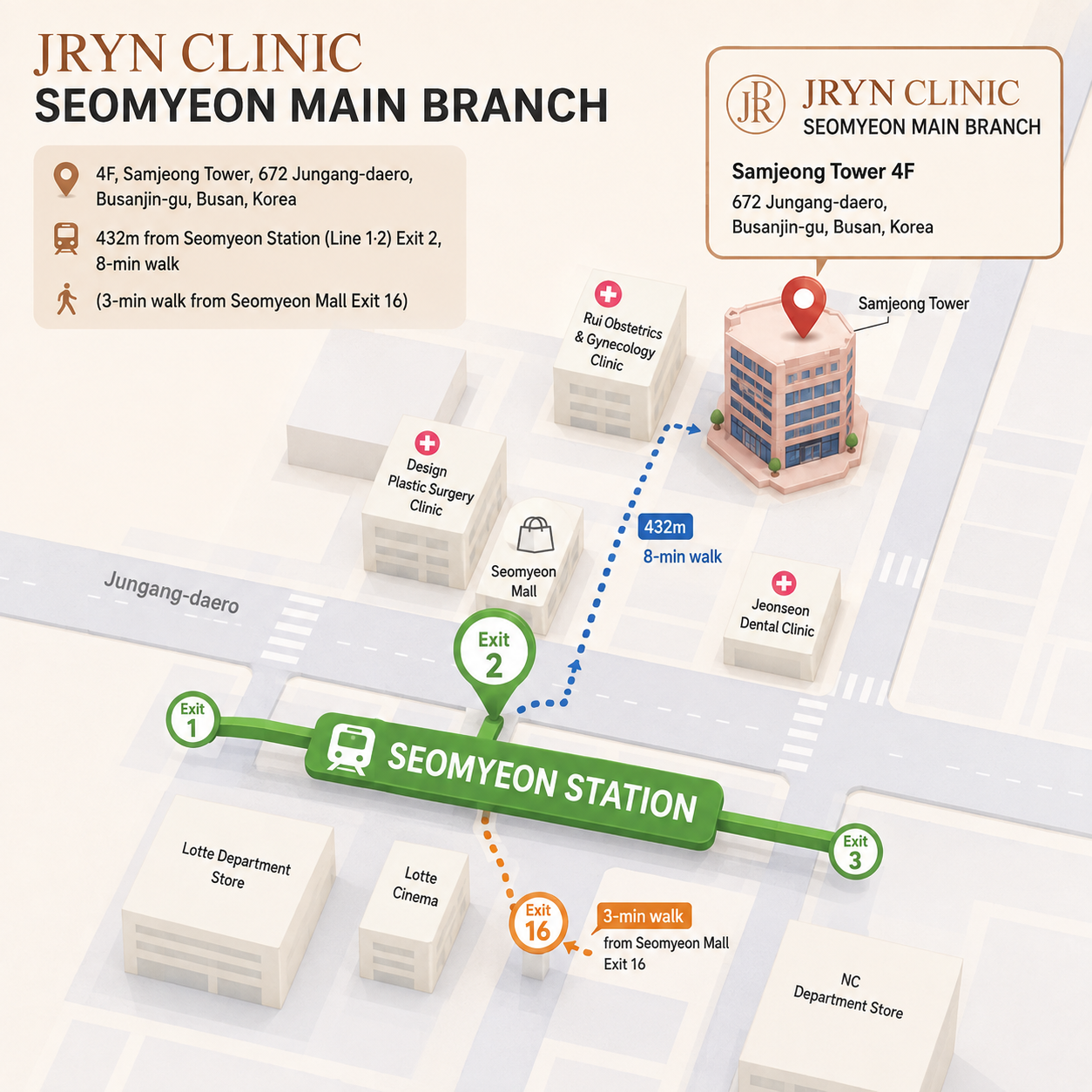
JRYN Dermatology Clinic – Seomyeon Main Branch
4F, Samjeong Tower
672 Jungang-daero
Busanjin-gu, Busan, Korea
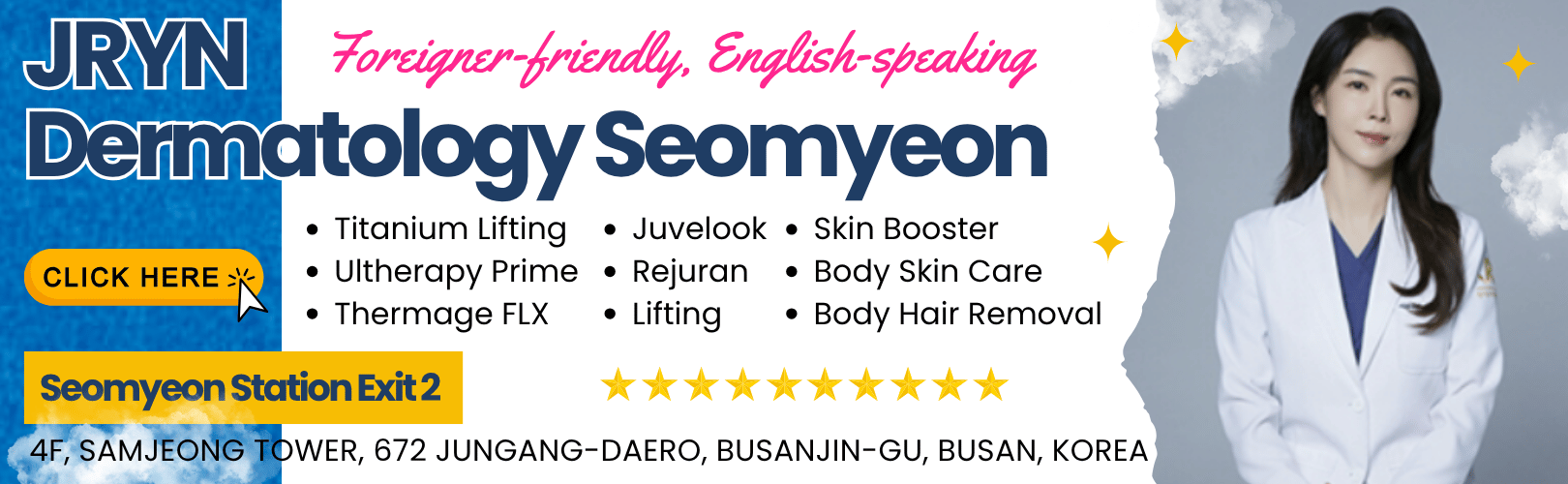
English Support Available